What is Dry Digestion Technology?
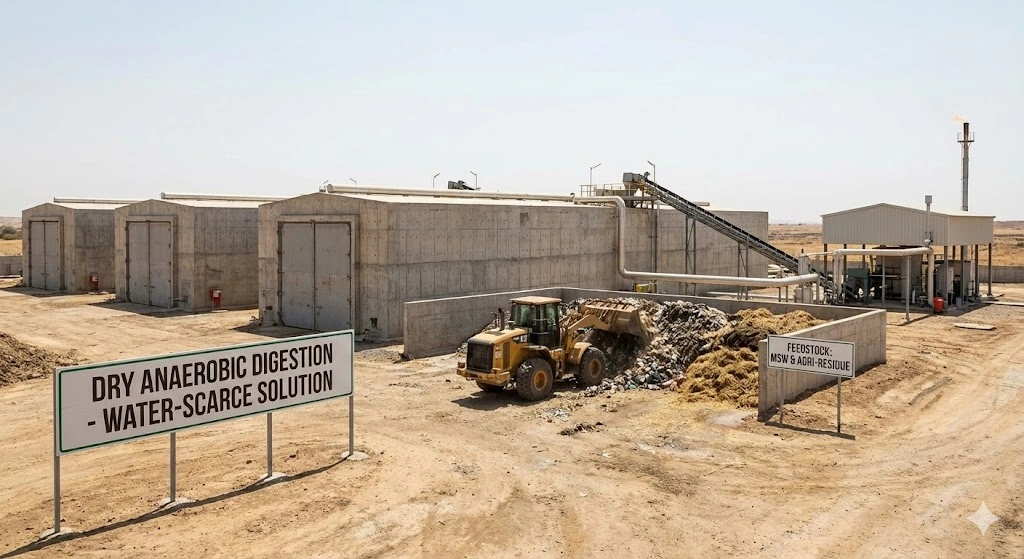
Dry Anaerobic Digestion is an innovative anaerobic digestion technology designed to process high-solid organic waste with minimal water addition. Unlike wet digestion systems, dry digestion operates with feedstock containing 20-40% total solids, making it ideal for water-scarce regions and high-solid waste streams.
This technology is particularly well-suited for processing municipal solid waste (MSW), agricultural residues, and other high-solid organic materials that would require significant dilution in conventional wet systems. Dry digestion systems offer significant water savings while maintaining efficient biogas production.
How Dry Digestion Technology Works
Understanding the process flow of dry anaerobic digestion-based Bio-CNG production
High-Solid Feedstock
Feedstock with 20-40% total solids (TS) is prepared with minimal water addition, making it suitable for dry digestion processing.
Batch or Continuous Digestion
High-solid feedstock is loaded into specialized digesters (batch or continuous) where it undergoes anaerobic digestion at 35-40°C for 20-40 days.
Biogas Production
Anaerobic microorganisms break down organic matter in the high-solid matrix, producing raw biogas containing 50-60% methane, 35-45% CO₂, and trace gases.
Upgrading & Compression
Biogas is collected, purified to >96% methane content, compressed to 200-250 bar, and stored as Bio-CNG. Solid digestate is removed for composting or use as fertilizer.
Key Features & Benefits
Minimal Water Requirement
Operates with 20-40% TS content, requiring minimal or no water addition, making it ideal for water-scarce regions and reducing operational costs.
MSW Processing
Excellent for processing municipal solid waste and agricultural residues that naturally have high solid content, eliminating the need for dilution.
Solid Digestate
Produces solid digestate that is easier to handle, transport, and use as compost or organic fertilizer compared to liquid digestate from wet systems.
Regional Suitability
Perfect for arid and semi-arid regions where water availability is limited, enabling Bio-CNG production in water-scarce areas.
Technical Specifications
Suitable Feedstocks
Dry digestion technology is ideal for high-solid organic waste streams and agricultural residues
Municipal Solid Waste
- Organic fraction of MSW
- Food waste
- Garden waste
- Market waste
Agricultural Residues
- Rice straw
- Wheat straw
- Corn stover
- Sugarcane bagasse
Other High-Solid Waste
- Yard waste
- Pruning waste
- Animal bedding
- Manure (high TS)
Applications & Use Cases
Where dry digestion technology provides optimal solutions
Water-Scarce Regions
Ideal for arid and semi-arid regions where water availability is limited, enabling Bio-CNG production without significant water consumption or competing with agricultural needs.
MSW Management
Perfect for municipal solid waste processing facilities where organic waste naturally has high solid content, eliminating the need for dilution and reducing processing costs.
Agricultural Waste Processing
Excellent for processing agricultural residues and crop waste that have naturally high solid content, making it a sustainable solution for rural Bio-CNG production.
Regional Suitability
Best suited for regions with limited water resources or where water costs are high, providing an environmentally sustainable alternative to wet digestion systems.
Advantages
- Minimal water requirement — Operates with 20-40% TS, ideal for water-scarce regions
- MSW processing — Excellent for municipal solid waste and high-solid organic waste
- Solid digestate — Easier to handle and use as compost or fertilizer
- Lower water costs — Reduced operational costs associated with water consumption
- Regional suitability — Perfect for arid and semi-arid regions
- Agricultural residues — Ideal for processing crop waste and agricultural by-products
Considerations
- Feedstock requirements — Requires high-solid feedstock (20-40% TS)
- Loading/unloading — Requires specialized equipment for handling high-solid materials
- Process control — May require more sophisticated monitoring for optimal performance
- Retention time — Longer HRT (20-40 days) compared to some wet systems
- Capital investment — Specialized equipment for high-solid handling may increase costs
- Feedstock preparation — May require size reduction and mixing for optimal digestion
Ready to Implement Dry Digestion Technology?
Partner with Hastus Energy for sustainable dry digestion-based Bio-CNG solutions. Perfect for water-scarce regions and high-solid waste processing.