What is CSTR Technology?
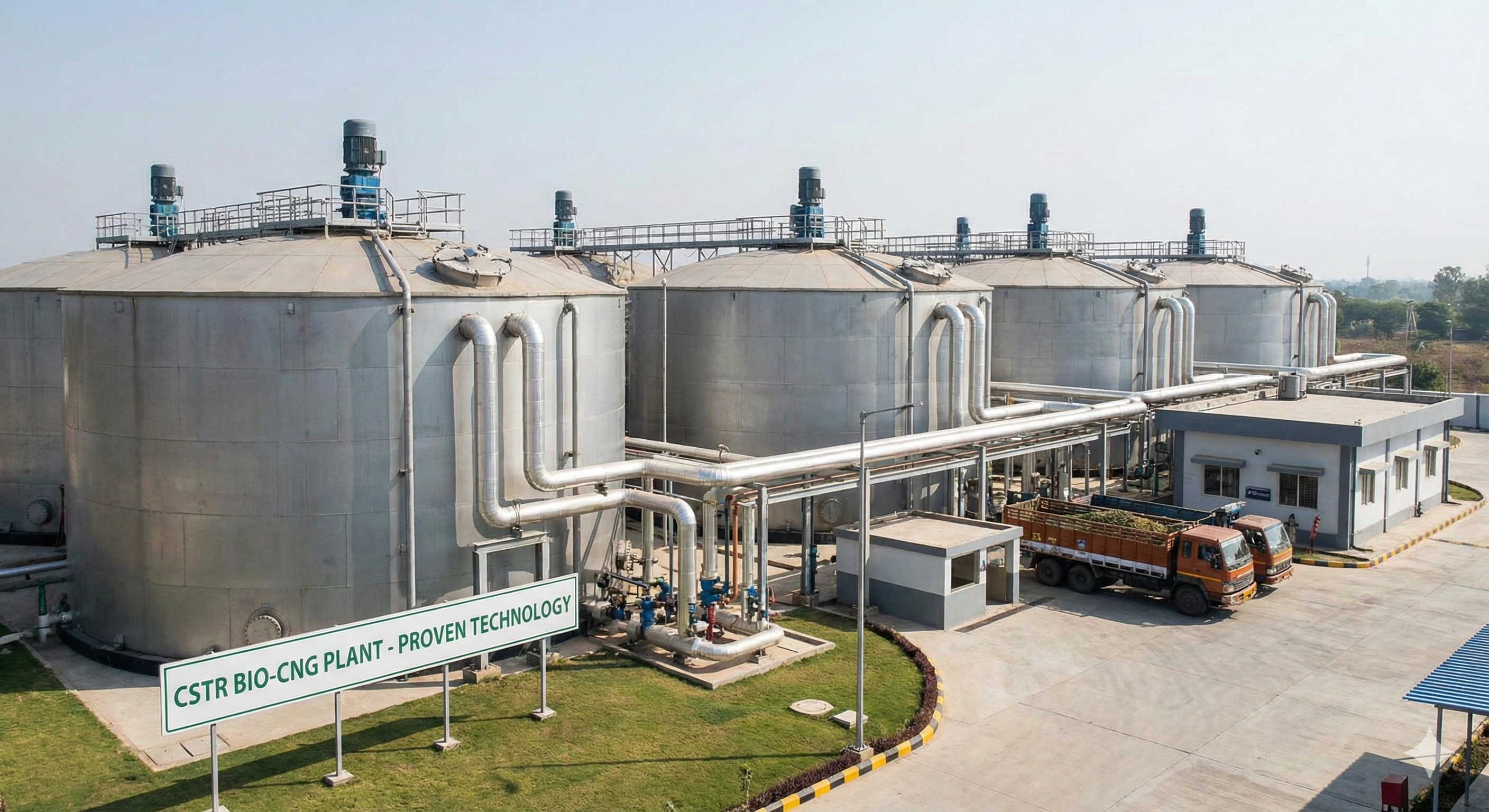
CSTR (Continuous Stirred Tank Reactor) is a wet anaerobic digestion system that uses continuous mechanical stirring to maintain homogeneous conditions throughout the digester. This technology is widely recognized as the most bankable and proven solution for Bio-CNG production from organic waste.
The continuous stirring ensures uniform distribution of microorganisms, temperature, and nutrients, resulting in optimal biogas production rates and consistent methane yields. CSTR systems are particularly well-suited for medium to large-scale operations where reliability and proven performance are critical.
How CSTR Technology Works
Understanding the process flow of CSTR-based Bio-CNG production
Feedstock Preparation
Homogeneous feedstock (8-12% TS) is prepared and mixed to ensure uniform consistency before entering the digester.
Continuous Digestion
Feedstock enters the CSTR digester where continuous mechanical stirring maintains homogeneous conditions at 35-40°C for 20-30 days.
Biogas Production
Anaerobic bacteria break down organic matter, producing raw biogas containing 55-60% methane, 35-40% CO₂, and trace gases.
Upgrading & Compression
Biogas is purified to >96% methane content, compressed to 200-250 bar, and stored as Bio-CNG for distribution.
Key Features & Benefits
Most Bankable Technology
CSTR is the most widely accepted technology by financial institutions and investors, making project financing easier to secure.
Proven Track Record
Extensive global deployment with thousands of successful installations, providing reliable performance data and operational experience.
Consistent Performance
Continuous stirring ensures uniform conditions, resulting in stable biogas production rates and predictable methane yields.
Scalable Design
Ideal for medium to large-scale operations (5 TPD to 100+ TPD), with modular designs allowing for capacity expansion.
Technical Specifications
Suitable Feedstocks
CSTR technology works best with homogeneous, pumpable feedstocks with moderate total solids content
Agricultural Residues
- Napier grass
- Bagasse
- Rice straw
- Wheat straw
Industrial Waste
- Press mud
- Distillery spent wash
- Food processing waste
- Dairy waste
Organic Waste
- Food waste
- Kitchen waste
- Market waste
- Animal manure
Applications & Use Cases
Where CSTR technology delivers optimal results
Large-Scale Commercial Plants
Ideal for commercial Bio-CNG plants with capacities ranging from 20-100+ TPD, where proven technology and bankability are critical for project success and financing.
Industrial Waste Management
Perfect for industries generating consistent, homogeneous organic waste streams such as sugar mills, distilleries, food processing units, and dairy plants.
Agricultural Waste Processing
Excellent for processing agricultural residues and energy crops where consistent feedstock quality can be maintained, enabling reliable biogas production.
Government & SATAT Projects
Preferred technology for government-backed projects and SATAT scheme implementations where proven track record and bankability are essential requirements.
Advantages
- Most bankable technology — Easier to secure project financing
- Proven reliability — Thousands of successful installations worldwide
- Consistent performance — Uniform conditions ensure stable biogas production
- Scalable design — Suitable for medium to large-scale operations
- Well-documented — Extensive operational data and best practices available
- Lower technical risk — Mature technology with established maintenance protocols
Considerations
- Feedstock requirements — Requires homogeneous, pumpable feedstock (8-12% TS)
- Water consumption — Higher water requirement compared to dry digestion systems
- Energy for stirring — Continuous mechanical stirring requires electrical energy input
- Digestate handling — Large volume of liquid digestate requires proper management
- Capital investment — Higher initial investment compared to simpler systems
- Retention time — Longer HRT (20-30 days) requires larger digester volumes
Ready to Implement CSTR Technology?
Partner with Hastus Energy for proven CSTR-based Bio-CNG solutions. Our expertise in design, engineering, and project management ensures successful implementation.